
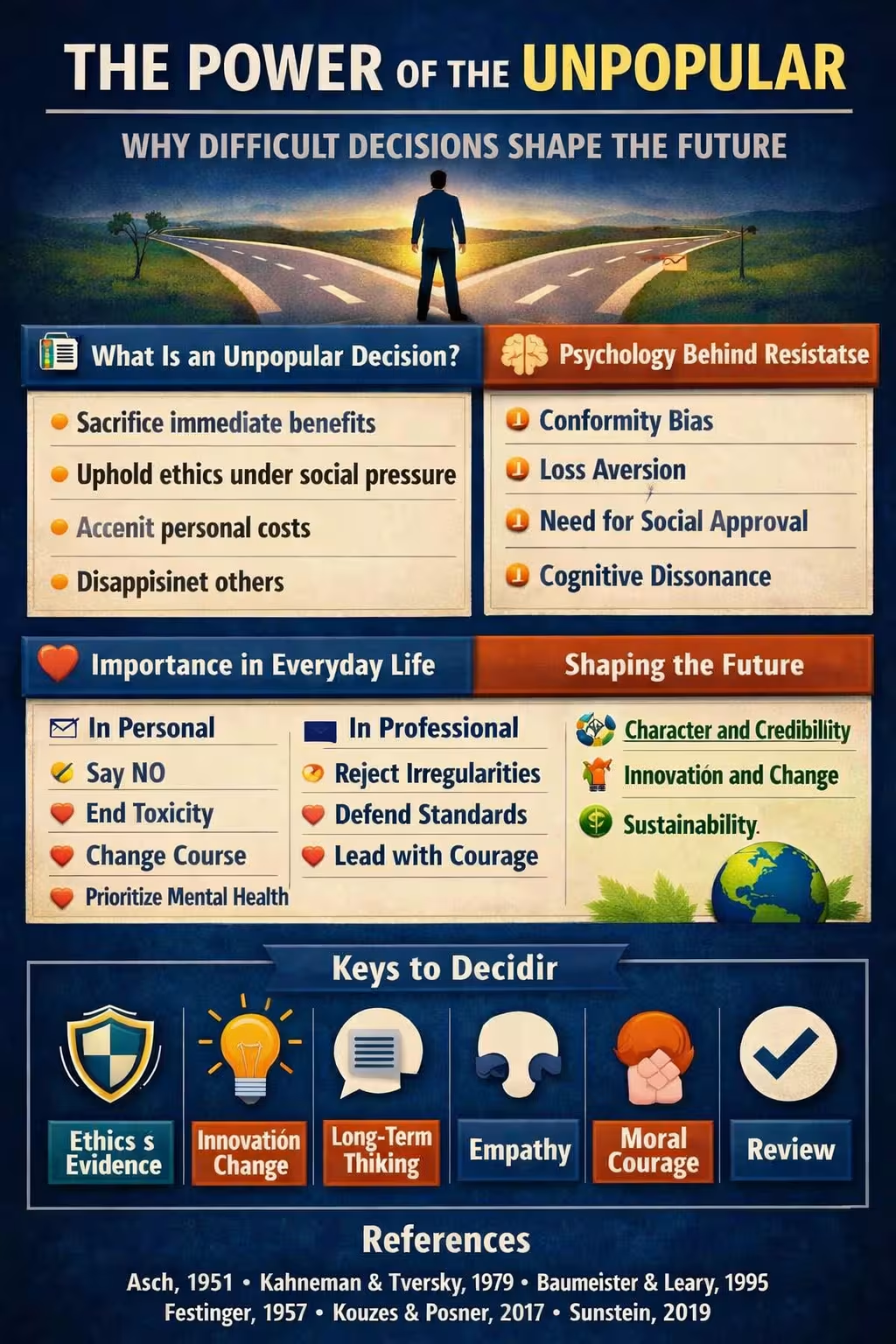
The Power of the Unpopular: Why Difficult Decisions Shape the Future
Executive Summary
Unpopular decisions—those that challenge expectations, disrupt comfort, or provoke resistance—are often the ones that most profoundly shape personal growth, organizational integrity, and societal progress. This article examines the psychology, ethics, and long‑term value of making difficult choices, supported by research in leadership, behavioral science, and social psychology.
1. What Is an Unpopular Decision?
An unpopular decision is a choice that, while rational, ethical, or necessary, faces opposition because it contradicts the desires, habits, or beliefs of a group. It is not contrarianism for its own sake; it is the willingness to choose what is right over what is comfortable.
Unpopular decisions often involve:
- Sacrificing short‑term comfort for long‑term benefit
- Upholding ethical standards under social pressure
- Accepting personal cost to protect principles
- Managing the emotional discomfort of disappointing others
2. Why Are They So Difficult? The Psychology Behind Resistance
Resistance to unpopular decisions is rooted in well‑documented psychological mechanisms:
- Conformity bias (Asch, 1951): People tend to align with the majority, even when the majority is wrong.
- Loss aversion (Kahneman & Tversky, 1979): Individuals prefer avoiding immediate losses over securing future gains.
- Need for social approval (Baumeister & Leary, 1995): Belonging is a fundamental human motivation.
- Cognitive dissonance (Festinger, 1957): Choices that contradict existing beliefs create psychological discomfort.
Thus, making an unpopular decision requires not only logical clarity but also emotional resilience and social courage.
3. The Importance in Everyday Life
Unpopular decisions are not exclusive to leaders; they appear constantly in daily life.
3.1. Personal Life
- Ending relationships that are no longer healthy
- Saying “no” to commitments that compromise well‑being
- Changing careers or countries despite family expectations
- Prioritizing mental health over social norms
These decisions often become turning points that redefine identity, autonomy, and purpose.
3.2. Professional Life
- Rejecting unethical practices
- Defending quality standards against pressure for speed
- Making evidence‑based technical decisions
- Taking responsibility for difficult leadership choices
In organizations, unpopular decisions are essential for reliability, safety, and operational excellence.
4. Why Unpopular Decisions Shape the Future
The future—personal, organizational, or societal—is built on decisions that were uncomfortable at the time they were made.
4.1. Character and Credibility
Leadership research (Kouzes & Posner, 2017) shows that credibility is built when actions align with values, especially under pressure.
4.2. Innovation and Change
Every innovation begins as an unpopular idea.
History shows that scientific, technological, and social progress often emerged from decisions initially rejected or misunderstood.
4.3. Sustainability and Long‑Term Thinking
In public policy, engineering, economics, and risk management, unpopular decisions often protect the future from invisible or underestimated threats.
5. How to Make Unpopular Decisions Responsibly
Scholars and leadership experts highlight several principles:
- Ethical clarity: Base decisions on values, not impulses
- Transparency: Communicate reasoning, criteria, and risks
- Evidence: Support decisions with data, not isolated intuition
- Empathy: Acknowledge emotional impact on others
- Moral courage: Stand firm when the decision is right
- Periodic review: Evaluate outcomes and adjust when necessary
6. Conclusion
Unpopular decisions are acts of maturity and responsibility. They are uncomfortable, but they build integrity, drive progress, and safeguard the future. In a world dominated by immediacy and social validation, the ability to choose what is right over what is popular becomes a strategic, ethical, and deeply human advantage.
References
- Asch, S. E. (1951). Effects of group pressure upon the modification and distortion of judgments.
- Baumeister, R. F., & Leary, M. R. (1995). The need to belong: Desire for interpersonal attachments as a fundamental human motivation. Psychological Bulletin.
- Festinger, L. (1957). A Theory of Cognitive Dissonance. Stanford University Press.
- Kahneman, D., & Tversky, A. (1979). Prospect Theory: An Analysis of Decision under Risk. Econometrica.
- Kouzes, J. M., & Posner, B. Z. (2017). The Leadership Challenge. Wiley.
- Pfeffer, J. (2015). Leadership BS: Fixing Workplaces and Careers One Truth at a Time. Harper Business.
- Schwartz, B. (2004). The Paradox of Choice. HarperCollins.
- Sunstein, C. R. (2019). Conformity: The Power of Social Influences. NYU Press.
Comments