
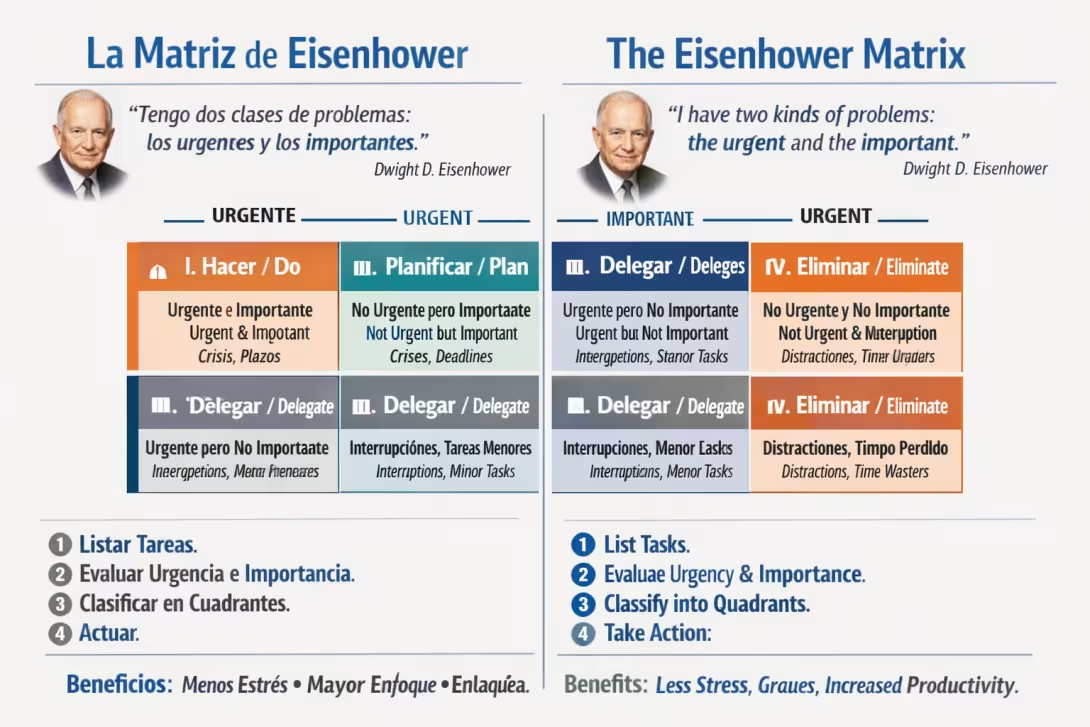
The Eisenhower Matrix: A Strategic Framework for Prioritization and Decision‑Making
1. Introduction
In an environment where professionals face increasing cognitive load, competing deadlines, and constant interruptions, the ability to prioritize effectively becomes a strategic advantage. The Eisenhower Matrix, also known as the Urgent–Important Matrix, remains one of the most influential tools for time management and decision‑making. Its enduring relevance lies in its simplicity: it helps individuals and organizations distinguish between what demands immediate attention and what truly drives long‑term value.
2. Historical Background
The matrix is attributed to Dwight D. Eisenhower, the 34th President of the United States and former Supreme Commander of the Allied Forces during World War II. Eisenhower was known for his disciplined approach to decision‑making. In a 1954 speech, he referenced a principle that later inspired the matrix:
“I have two kinds of problems: the urgent and the important. The urgent are not important, and the important are never urgent.”
This idea was later formalized and popularized by Stephen R. Covey in The 7 Habits of Highly Effective People (1989), where he introduced the matrix as a practical tool for personal and organizational productivity.
3. Definition of the Eisenhower Matrix
The Eisenhower Matrix is a four‑quadrant prioritization framework that classifies tasks based on two dimensions:
- Urgency: Requires immediate attention.
- Importance: Contributes to long‑term goals, values, or strategic outcomes.
By cross‑referencing these dimensions, the matrix guides users toward the most effective action for each type of task.
4. The Four Quadrants
Quadrant I — Urgent and Important (Do)
Tasks that require immediate action and have significant consequences if delayed.
Examples: operational crises, urgent deadlines, safety issues.
Quadrant II — Not Urgent but Important (Plan)
Strategic, high‑value activities that contribute to long‑term success.
Examples: planning, training, preventive maintenance, continuous improvement.
Quadrant III — Urgent but Not Important (Delegate)
Tasks that demand quick attention but do not significantly contribute to strategic goals.
Examples: interruptions, minor requests, administrative tasks.
Quadrant IV — Not Urgent and Not Important (Eliminate)
Low‑value activities that consume time without contributing to meaningful outcomes.
Examples: excessive social media, trivial tasks, non‑productive entertainment.
5. Applications and Benefits
The Eisenhower Matrix is widely used in leadership, project management, reliability engineering, and personal productivity. Its benefits include:
- Increased clarity in decision‑making.
- Reduction of stress caused by reactive work.
- Stronger alignment with strategic objectives.
- Improved delegation practices.
- Greater focus on long‑term value creation.
In industrial and operational environments, Quadrant II activities—such as preventive maintenance, training, and process optimization—are particularly critical for reliability and operational excellence.
6. Implementation Steps
- List all tasks or responsibilities.
- Evaluate each task based on urgency and importance.
- Assign each task to a quadrant.
- Apply the corresponding action:
- Do
- Plan
- Delegate
- Eliminate
- Review and adjust regularly, especially in dynamic operational contexts.
7. Limitations
While powerful, the matrix has limitations:
- It depends on accurate judgment of urgency and importance.
- It may oversimplify complex tasks with dependencies.
- It requires discipline to maintain, especially in high‑pressure environments.
Nonetheless, when used consistently, it becomes a cornerstone of effective time and task management.
8. Conclusion
The Eisenhower Matrix remains a timeless and practical tool for prioritization. Its structured approach helps individuals and organizations shift from reactive behavior to strategic action, enabling better performance, reduced stress, and sustained long‑term results. In fields such as reliability, safety, and operational excellence, its value is particularly evident: focusing on what truly matters is the foundation of continuous improvement.
9. Bibliographic References
Books and Foundational Works
- Covey, S. R. (1989). The 7 Habits of Highly Effective People. Free Press.
- Drucker, P. (1967). The Effective Executive. Harper & Row.
- Morgenstern, J. (2004). Time Management from the Inside Out. Henry Holt.
Academic and Professional Sources
- Lakein, A. (1973). How to Get Control of Your Time and Your Life. New American Library.
- Macan, T. H. (1994). “Time Management: Test of a Process Model.” Journal of Applied Psychology, 79(3), 381–391.
- Aeon, B., & Aguinis, H. (2017). “It’s About Time: New Perspectives and Insights on Time Management.” Academy of Management Perspectives, 31(4), 309–330.
Online Resources
- Eisenhower Presidential Library. “Dwight D. Eisenhower Quotations.”
- MindTools. “The Eisenhower Matrix: Prioritizing Tasks by Urgency and Importance.”
- Harvard Business Review. “Manage Your Energy, Not Your Time.”
Comments