
You Are Better Than You Think: A Reflection on Insecurity, Competence, and Human Potential
Tim Ferriss’ well‑known quote — “If you’re insecure, guess what? The rest of the world is too. Don’t overestimate the competition and don’t underestimate yourself. You are better than you think.” — has become a powerful reminder for anyone who struggles with self‑confidence. Beyond its motivational appeal, this idea is strongly supported by decades of research in cognitive psychology, human behavior, and professional performance.
1. Insecurity as a Universal Human Experience
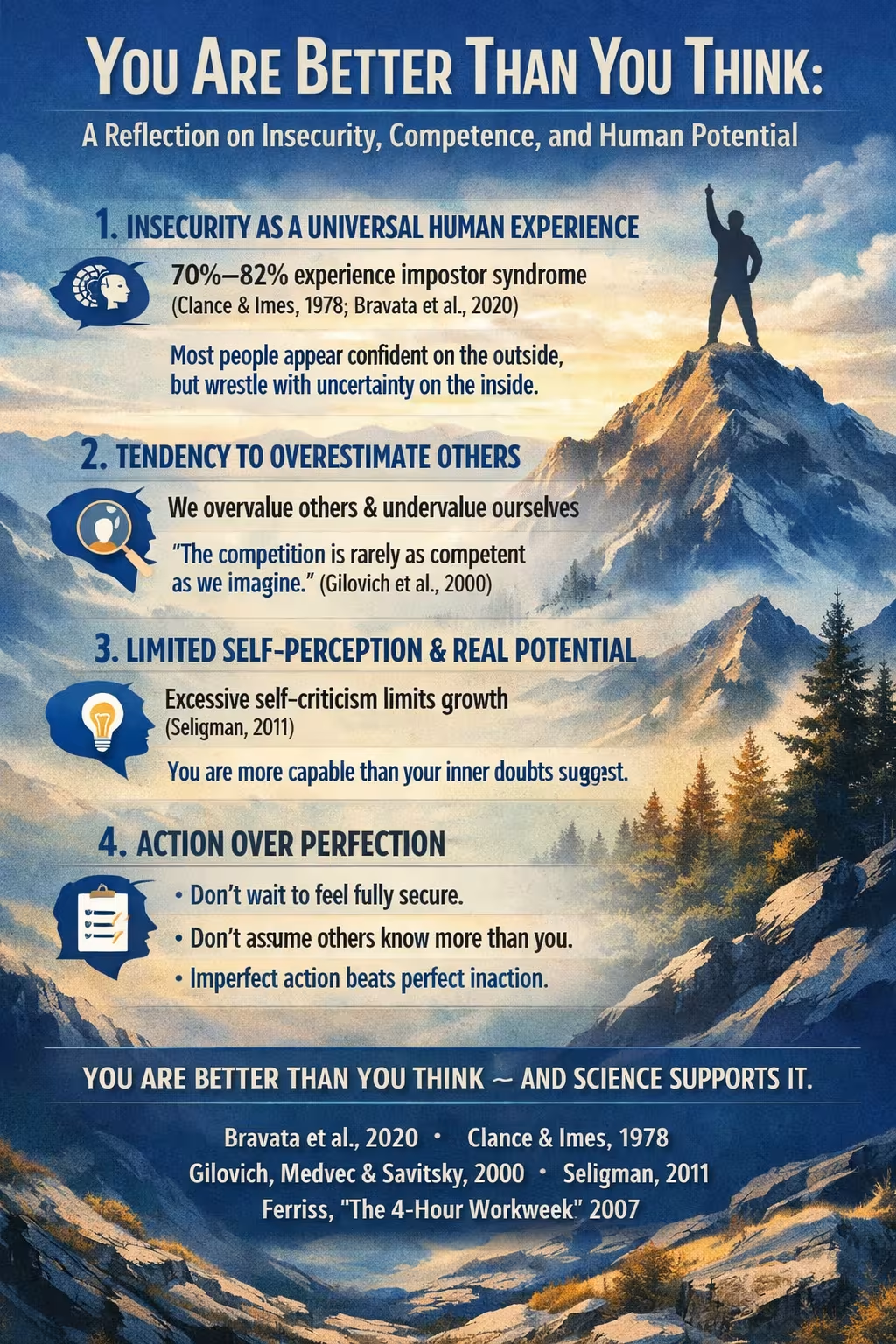
Insecurity is not a personal flaw; it is a shared human condition. Research on the impostor syndrome shows that between 70% and 82% of people experience significant self‑doubt at some point in their professional lives (Clance & Imes, 1978; Bravata et al., 2020). This includes students, professionals, executives, and even recognized experts.
Ferriss’ statement resonates because it exposes a hidden truth:
most people appear confident on the outside while wrestling with uncertainty on the inside.
2. The Tendency to Overestimate Others
Social psychology has demonstrated that humans systematically overvalue the abilities of others while undervaluing their own. This distortion is linked to the spotlight effect and the illusion of transparency, where individuals believe their flaws are more visible than they actually are (Gilovich, Medvec & Savitsky, 2000).
Ferriss’ message challenges this cognitive bias:
the competition is rarely as competent, prepared, or confident as we imagine.
3. Limited Self‑Perception and Real Potential
Excessive self‑criticism often becomes a barrier to growth. Studies in positive psychology show that people tend to ignore their strengths and focus disproportionately on weaknesses, reducing motivation and performance (Seligman, 2011).
Ferriss encourages a shift in perspective:
you are more capable than your internal narrative suggests.
Confidence — even before full competence — drives action, and action produces learning, mastery, and results.
4. Action Over Perfection: The Core Message
The deeper meaning of Ferriss’ quote is profoundly practical:
- Do not wait to feel completely secure.
- Do not assume others know more than you.
- Do not let comparison paralyze you.
Most meaningful personal and professional progress happens when someone decides to act despite uncertainty. As Ferriss emphasizes in The 4‑Hour Workweek, imperfect action beats perfect inaction.
Conclusion
Tim Ferriss’ message is more than motivational rhetoric: it is an invitation to reinterpret insecurity as a natural part of human development. When we stop idealizing others and stop diminishing ourselves, we create space to discover our true potential.
You are better than you think — and science supports it.
References
- Bravata, D. M., et al. (2020). Prevalence, Predictors, and Treatment of Impostor Syndrome: A Systematic Review. Journal of General Internal Medicine.
- Clance, P. R., & Imes, S. A. (1978). The Imposter Phenomenon in High Achieving Women. Psychotherapy: Theory, Research & Practice.
- Ferriss, T. (2007). The 4‑Hour Workweek. Crown Publishing Group.
- Gilovich, T., Medvec, V. H., & Savitsky, K. (2000). The Spotlight Effect in Social Judgment. Journal of Personality and Social Psychology.
- Seligman, M. E. P. (2011). Flourish: A Visionary New Understanding of Happiness and Well‑being. Free Press.
Comments