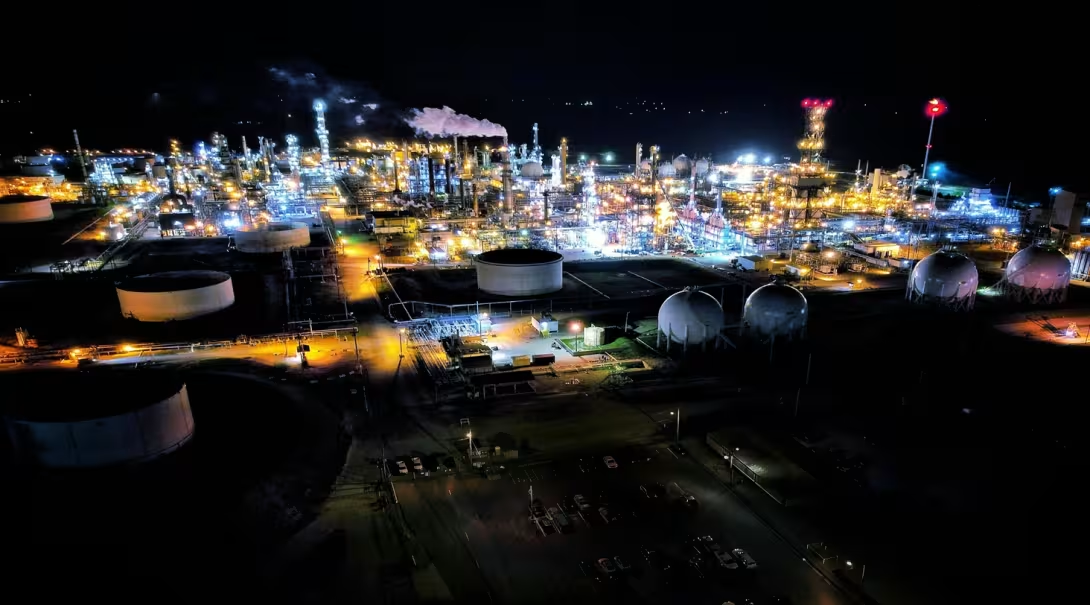
For the next five years (2026–2031), global oil refinery construction will undergo a profound geographical shift. The market is set to add nearly 5.8 million barrels per day (mb/d) of new capacity. 90% of these projects will be heavily clustered in three specific regions: Asia-Pacific, Africa, and the Middle East.
The sector's primary focus has moved away from producing standard conventional fuels. Instead, the market is driven by deep petrochemical integration, heavy crude desulfurization, and the inclusion of biofuels and green hydrogen plants.
1. Top Countries with Major Projects Under Construction
- China 🇨🇳: The absolute global leader in infrastructure additions. Its strategy focuses on massive integrated complexes built on artificial islands and costal economic zones. The ultimate goal is to displace Western competitors in supplying advanced plastics and chemical resins.
- India 🇮🇳: The second-largest growth engine in Asia. It is developing mega-expansion projects tailored to meet its massive domestic demand while exporting high-purity fuels to European markets.
- Iran 🇮🇷: Despite geopolitical challenges, the country holds one of the largest planned project pipelines globally by nominal crude volume. It aims to process its domestic heavy resources locally for Asian markets.
- Nigeria 🇳🇬: Leading infrastructure development across the African continent. Its priority is securing regional energy self-sufficiency and curbing its historic reliance on imported gasoline.
- Saudi Arabia 🇸🇦: Maintaining multi-billion-dollar investments to scale up conversion capacity. The kingdom's goal is to stop exporting unrefined crude, transforming it domestically into high-value chemical products.
2. Key Operators and Construction Companies
Project development is split between the state-owned enterprises financing the works and the international consortia building them.
Project Owners / Promoters
- Sinopec and PetroChina (China): State-owned corporations commanding the world's largest investments in integrated refining.
- Reliance Industries and Nayara Energy (India): Leading the optimization of the Jamnagar complex and the massive expansion of the Vadinar refinery.
- Dangote Group (Nigeria): The private conglomerate driving expansions to double the capacity of its flagship mega-plant.
- Saudi Aramco (Saudi Arabia): The state oil giant behind new advanced refining trains and crude-to-chemical conversions.
Engineering & Construction Companies (EPC Contractors)
- Samsung E&A and Hyundai E&C (South Korea): Dominant firms that have captured the fast-track procurement and construction contracts across Asia and the Middle East.
- Sinopec Engineering Group - SEG (China): The largest builder of domestic refining infrastructure, with a growing footprint exporting services to Africa.
- Técnicas Reunidas (Spain) and Technip Energies (Francia): The preferred European engineering firms for the technical design of deep conversion units and emissions-reduction blocks.
3. Primary Business Areas of New Projects
Megaprojects for this five-year period are no longer designed under last-century concepts. Investments are strictly divided into three business verticals:
- Crude-to-Chemicals Deep Integration (COTC): This is the largest area of investment. New plants drastically reduce traditional gasoline yields to maximize olefins, aromatics, polyethylene, and feedstocks for the pharmaceutical and consumer goods industries. The Shandong Yulong project in China is a prime example of this transition.
- Deep Conversion & Ultra-Clean Fuels (Euro VI): Massive projects relying on advanced hydrocracking and coking units. They are specifically engineered to transform low-cost, heavy crude into diesel and aviation fuel (Jet Fuel) with a sulfur content close to zero parts per million (ppm).
- Hybrid Systems & Active Decarbonization: Virtually 100% of the refineries scheduled to enter operation toward 2030 integrate carbon capture facilities and green hydrogen production units to power their own hydrotreaters, reducing the direct environmental footprint of industrial operations.
- Log in to post comments
Comments